

“What grade would you give the German school system when it comes to migration and diversity? Innovation? Colonial history?”
That provocative question set the tone for our first-ever educational networking event on February 23 — and for a conversation that was both critical and constructive from the very beginning.
With this event, Migration Matters took a new step in connecting conversations on migration more directly with the education sector. Held at the International Alumni Center in Berlin, the evening brought together participants from education, civil society, research, funding, and public administration.
At the heart of the event was one guiding question: How do we talk about migration and diversity — and why does that matter for education?

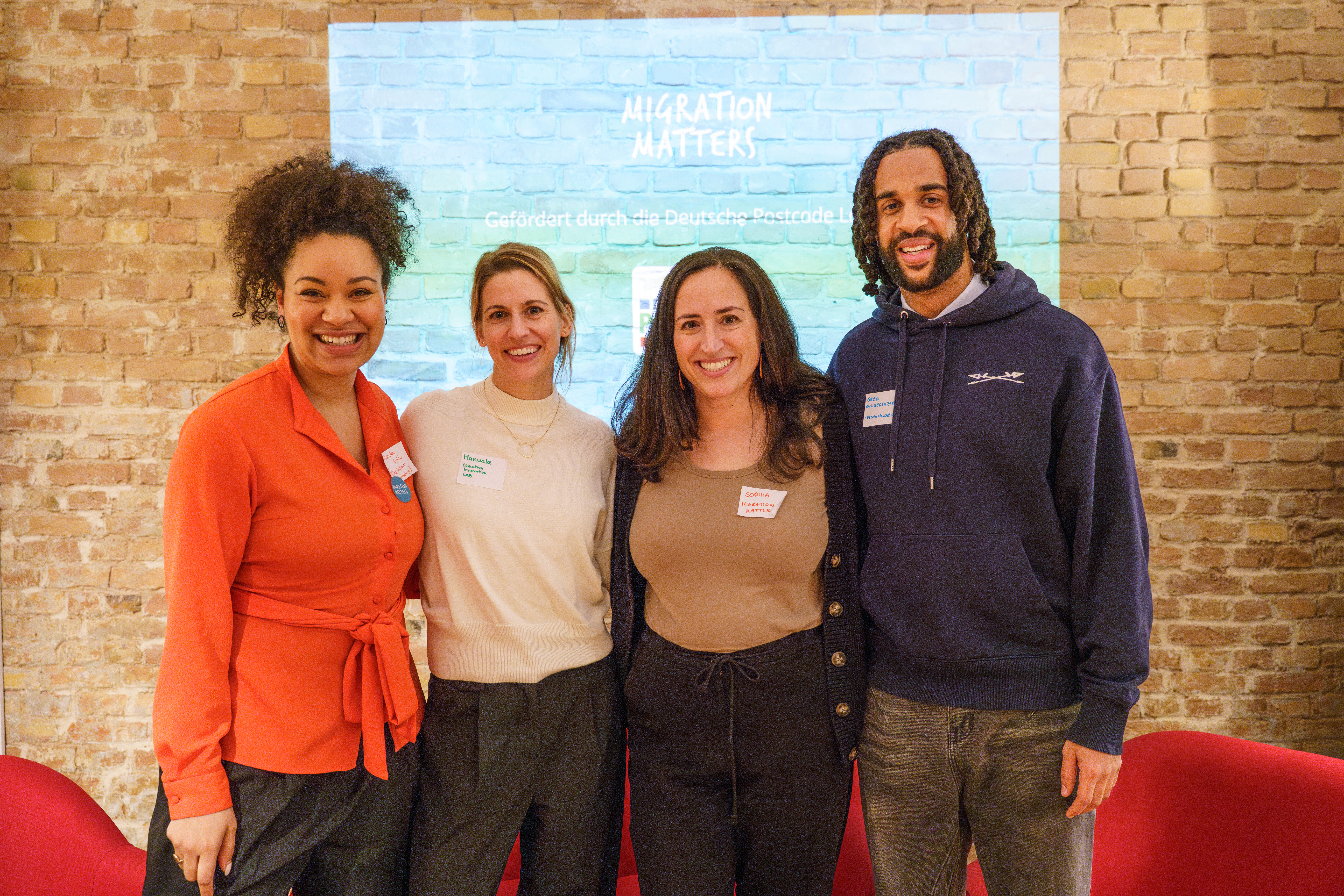
To explore this question, we invited three panel speakers whose work engages with education and migration in distinct but complementary ways:
Manuela Mohr (Founder & CEO, Education Innovation Lab) focused on structural transformation and the need for innovation that reflects lived social realities rather than outdated system logics.
Greg Onwuegbuzie (Founder, Deschoolonize) addressed colonial continuities within education and questioned whose knowledge is considered legitimate.
Sophia Burton (Co-Founder & Managing Director, Migration Matters) spoke about migration narratives in media and public discourse — and how they shape perceptions and learning environments.
Together, the panelists outlined where we currently stand when it comes to migration and diversity in education — and where change is needed. From transforming institutional structures to critically examining whose knowledge is centered, to reshaping narratives with greater nuance and context, the discussion made clear that education does not exist in isolation from broader societal debates.
Moderated by Yolanda Rother (The Impact Company), the discussion quickly moved beyond abstract debates. Schools and educational institutions are not neutral spaces; they are embedded in political, historical, and social contexts. When migration and diversity are reduced in public discourse to binaries such as “crisis vs. control” or “us vs. them,” those simplifications do not remain in headlines. They enter classrooms, shape institutional cultures, and influence how young people understand themselves and others.
A key thread throughout the evening was the question of representation: Which perspectives are centered? Which voices are missing? And how can education move beyond reinforcing misconceptions and stereotypes toward fostering belonging, participation, and critical reflection?
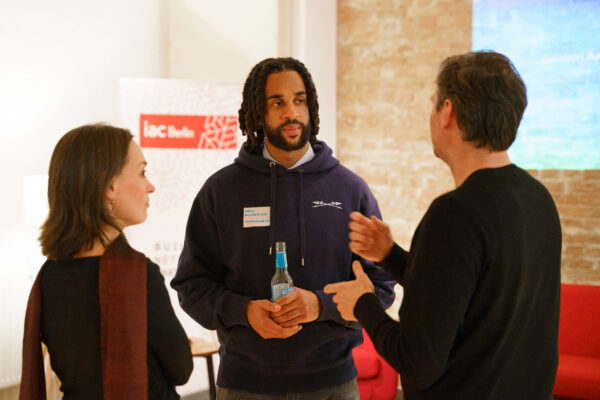
The panel was followed by an open networking session that allowed participants to continue the exchange in smaller groups. Experiences were shared, ideas debated, and new connections formed across sectors. This closing part of the evening highlighted that meaningful change requires dialogue — and dialogue requires space.


For Migration Matters, this new event format marked an important milestone. Bringing together actors from different fields to jointly reflect on narratives, education, and systemic change felt both energizing and necessary.
We are grateful to everyone who contributed their perspectives and energy to the evening, and we look forward to creating more spaces like this in the future.
Thank you to the International Alumni Center for hosting us and to the Deutsche Postcode Lotterie for their support in making the evening possible.
Photos by Allan Whyte