


By Lina Zoubir
It hasn’t been long since I sat in a classroom myself, and like many students in the room, I learned about the causes and consequences of climate change, but one aspect was often missing from the conversation: its complex relationship to migration. That’s what we set out to explore with the students of the Freie Waldorfschule Südost in Berlin Treptow-Köpenick. Migration Matters was invited to take part in their “Couragetag” (Courage Day), a day during which students swap regular classes for projects and workshops about different forms of discrimination and other societally relevant topics.
We kicked off the workshop with a guessing activity. Students were shown images of four different climate hazards and, in small groups, had to guess where and what exactly was depicted. Many were surprised to learn that the image of the aftermath of the 2021 floods in Erfstadt had been taken not far from where they sat. The recent floods in Nepal and this summer’s wildfires in France also came up in our discussions. The activity comes from the Teaching Immigration in European Schools (TIES) module on climate change and migration, which features Migration Matters material and is freely available for teachers to use.

A student answering questions from the TIES activity sheet.
Students then took a closer look at the four events, including the rising sea levels in Kiribati and the 2021 floods in Germany, and at how affected communities and states responded. When asked, “What would you do in this situation?” many answered that they too would leave their homes. Through further interactive role-playing exercises, students explored how climate change interacts with other economic, social, and political factors to shape migration decisions. Who stays, who moves, and who has the resources and opportunities to make those choices?
To consolidate what they had learned (and because young people enjoy a good video in class), we showed Escaping the Elements: The truth behind Climate Migration, produced by Sophia and Adam Levy, known as Climate Adam on YouTube. The video brought key concepts together, such as climate change as a “threat multiplier,” migration as “multicausal”, and the idea of increased vulnerability. It also showed students why media headlines on these topics deserve scrutiny. Sophia pointed out that only 3.7% of the world population are international migrants, a number that surprised many students (International Organization for Migration, 2026).
After the lunch break, Segun Charles Sule from the alternative tour group querstadtein joined us and shared a more personal story about how climate change, mobility, and conflict intersect in his home country, Nigeria. His perspective reminded students that most climate-induced migration happens regionally or within a country’s borders.

Segun showed a photo of drought to illustrate how climate change is affecting communities in Nigeria.
To wrap up our workshop, we turned to one of our Big Climate Movement videos, in which young climate activists, alongside researchers Yvonne Su, François Gemenne, and Caroline Zickgraf, share their takes on climate justice. Students then wrote down their thoughts and ideas on how we, as individuals, can contribute to climate justice. Their suggestions included avoiding fast fashion, flying less, using more climate-friendly transportation such as bicycles and public transportation (ÖPNV), recycling, using more renewable energy, using less AI, cutting down fewer trees, and supporting climate projects. Their ideas were a good reminder that climate justice starts with everyday choices, but also that it depends on bigger political and economic changes.
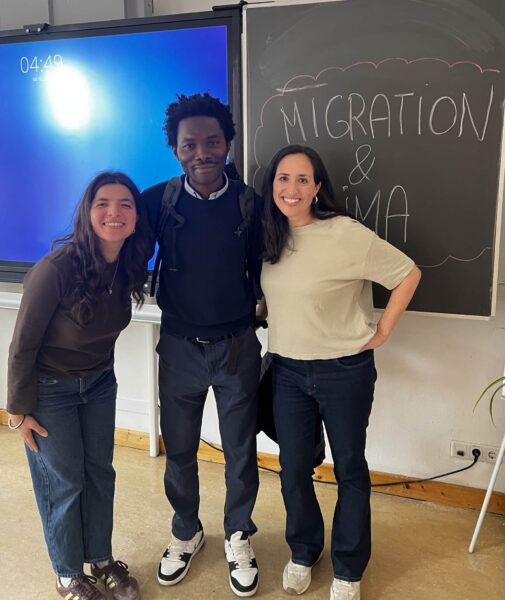
The workshop team (from left): Lina Zoubir (MM), Segun Charles Sule (querstadtein) and Sophia Burton (MM)
This workshop series is supported by Engagement Global with funding from the German Federal Ministry for Economic Cooperation and Development (BMZ), as well as the Berlin Senate Department for Economic Affairs, Energy and Public Enterprises. If you’re interested in us coming to your school, reach out to us at team@migrationmatters.me and include “school workshop” in the subject line.
Sources:
International Organization for Migration. (2026). World migration report 2026. https://worldmigrationreport.iom.int/msite/wmr-2026-interactive/